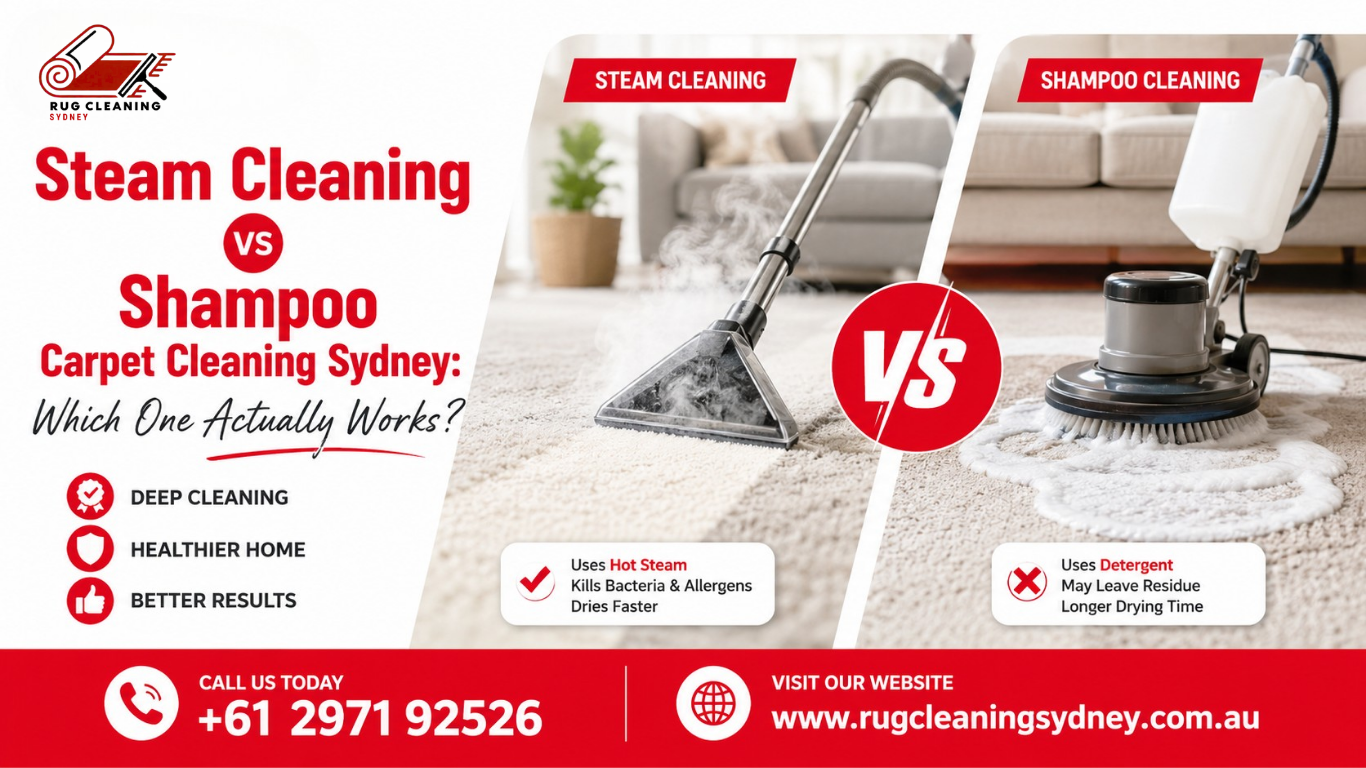
Shampoo carpet cleaning Sydney uses a rotary machine to work foaming detergent into carpet fibres, which is then vacuumed out after drying. Steam cleaning (hot water extraction) injects hot pressurised water deep into the pile and extracts it immediately. Steam cleaning removes more allergens and soil, leaves less residue, and is the method recommended by most carpet manufacturers for Sydney homes.
Published: June 2026 | Category: Carpet Cleaning Tips | Author: Rug Cleaning Sydney Team
You've seen both offered. You're not sure which one your carpet actually needs.
Shampoo carpet cleaning and steam cleaning are the two most commonly searched carpet cleaning methods in Sydney — and they produce very different results. One leaves residue behind. One doesn't. One suits certain carpet types. One doesn't. Get this choice wrong and you can end up with carpets that re-soil faster, smell damp, or come out looking worse than before.
This guide breaks down exactly how each method works, which Sydney carpet types suit which, and which one gives you better value over time. No fluff — just the facts you need before you book.
Table of Contents
- What Is Shampoo Carpet Cleaning?
- What Is Steam Cleaning (Hot Water Extraction)?
- Head-to-Head Comparison: Shampoo vs Steam
- Which Method Suits Which Carpet Type?
- The Re-Soiling Problem: Why Residue Matters
- Carpet Cleaning Costs in Sydney: Shampoo vs Steam
- When to Use Shampoo Cleaning (And When Not To)
- People Also Ask
- Frequently Asked Questions
What Is Shampoo Carpet Cleaning?
Shampoo carpet cleaning is one of the oldest professional methods — and it's still in use today, though mostly for specific situations.
Here's how it works:
- A foaming detergent solution is applied to the carpet
- A rotary brush machine scrubs the solution deep into the fibres
- The foam encapsulates loosened dirt and debris
- The carpet dries — usually 4–8 hours
- The dried foam residue (containing trapped soil) is vacuumed away
It was the dominant cleaning method through the 1970s and 80s. Today, hot water extraction has largely replaced it for standard residential cleaning. But carpet shampoo is still used in specific commercial settings — high-traffic corridors, venues that need to stay operational, or areas where drying time needs to be controlled.
The main limitation of shampoo cleaning
No matter how well you vacuum, some detergent residue stays in the fibres. You won't see it — but it's there. That residue is sticky. It attracts new soil faster than a clean carpet would.
This is called rapid re-soiling, and it's the most common complaint about shampoo carpet cleaning. Your carpet looks clean right after — then within weeks, it looks almost as dirty as before you cleaned it.
In Sydney's environment — where dust, coastal grit, and humidity are all factors — this residue issue is especially noticeable.
What Is Steam Cleaning (Hot Water Extraction)?
Despite being called "steam cleaning," hot water extraction doesn't actually use steam. The name stuck — but the process is different and more effective.
Here's what actually happens:
- A pre-treatment solution is applied to loosen embedded soil
- Hot water (60–90°C) is injected under pressure deep into the carpet pile
- A high-powered extraction unit immediately pulls the water back out — along with dissolved soil, allergens, bacteria, and debris
- Carpets are left slightly damp and dry in 4–8 hours (sometimes faster with airflow)
Because the water is extracted almost immediately, very little moisture remains in the fibres. And because no foaming agent is left behind, there's no sticky residue to attract new soil.
Shampoo cleaning uses foaming detergent worked in by a rotary brush, then vacuumed out after drying. Steam cleaning (hot water extraction) injects hot pressurised water deep into the pile and extracts it immediately. Steam cleaning removes more allergens, leaves less residue, dries faster, and is recommended by most carpet manufacturers for residential use in Sydney.
Why most Sydney carpet manufacturers recommend hot water extraction
Shaw, Godfrey Hirst, Cavalier Bremworth — the major carpet brands all specify hot water extraction as the required cleaning method to maintain warranty. This alone is worth noting before you choose a method.
The IICRC (Institute of Inspection, Cleaning and Restoration Certification) also designates hot water extraction as the industry standard for residential carpet cleaning. It's the method Rug Cleaning Sydney uses as their primary technique for wall-to-wall carpets.
Head-to-Head Comparison: Shampoo vs Steam
Side by side, here's how the two methods compare across every factor Sydney homeowners should consider:
| Factor | Shampoo Cleaning | Steam Cleaning (HWE) |
|---|---|---|
| Cleaning depth | Surface to mid-pile | Deep pile + backing |
| Allergen removal | Partial | 98%+ removed |
| Residue left behind | Yes — detergent residue | Minimal to none |
| Re-soiling risk | High (residue attracts dirt) | Low |
| Drying time | 4–8 hours | 4–6 hours (or less) |
| Pet odour removal | Masks, doesn't eliminate | Breaks down uric acid |
| Mould risk | Higher (foam can trap moisture) | Lower (extraction removes water) |
| Manufacturer warranty | Often not accepted | Required by most brands |
| Suitability for wool | Risk of fibre damage | Safe with correct settings |
| IICRC standard | Not the primary recommendation | Industry standard method |
| Cost (Sydney avg.) | $100–$200 | $150–$400 |
| Longevity of clean | 3–6 months before re-soiling | 12–18 months |
The verdict is clear on most fronts. Steam cleaning costs more upfront — but the clean lasts significantly longer, leaves no residue, and is safer for almost every carpet type. For most Sydney households, the extra cost per session is offset by needing fewer sessions per year.
Which Method Suits Which Carpet Type?
Not all carpets are the same — and the right method depends on what's on your floor.
Synthetic carpets (nylon, polyester, polypropylene)
These are the most common carpet types in Sydney homes and rental properties. Both methods work — but hot water extraction wins on depth of clean and allergen removal. Shampoo cleaning is acceptable for maintenance cleans between deeper sessions.
Wool carpets
Wool is sensitive. High-alkaline shampoo products can strip the natural lanolin from wool fibres, causing dryness and brittleness over time. Hot water extraction with pH-neutral solutions is the safer choice. If someone quotes you shampoo cleaning for a wool carpet, ask specifically what products they're using and their pH level.
Berber and loop-pile carpets
The looped construction of Berber carpet traps detergent residue particularly effectively — which means shampoo cleaning causes faster re-soiling on this type than almost any other. Hot water extraction is strongly recommended.
Handmade rugs (Persian, Oriental, wool)
Neither in-home carpet cleaning method is appropriate for handmade rugs. These require specialist off-site immersion washing — a completely different process. Using a rotary shampoo machine or even a standard steam cleaner on a hand-knotted Persian rug can cause dye bleed, shrinkage, and irreversible fibre damage.
If you have a rug as well as carpets to clean, it's worth reading our Persian rug cleaning Sydney guide before booking — the processes are very different.
The Re-Soiling Problem: Why Residue Matters More Than You Think
This is the hidden cost of shampoo carpet cleaning that most people don't factor in.
When foaming detergent residue stays in carpet fibres, it acts like a magnet for airborne dust, foot traffic debris, and pet dander. The fibres become sticky at a microscopic level. Soil particles cling rather than sitting loose on the pile where vacuum cleaners can reach them.
The result: your carpet re-soils 2–3x faster after a shampoo clean than it would after hot water extraction.
What this means for Sydney homeowners in practice
Say you get a shampoo clean in January. By April, the carpet looks almost as dirty as before. You book again. By October, same story. You're now cleaning 2–3 times per year instead of once.
Over a 5-year period:
| Method | Cleans per year | Cost per clean (avg) | 5-year total |
|---|---|---|---|
| Shampoo cleaning | 2–3x | $150 | $1,500–$2,250 |
| Steam cleaning (HWE) | 1x | $250 | $1,250 |
Shampoo cleaning isn't cheaper long-term — it just feels cheaper per session. The re-soiling cycle means you're paying more often, and your carpet fibre is experiencing more wear from more frequent machine passes.
This is especially relevant for high-traffic Sydney rental properties where landlords often default to shampoo cleaning between tenancies to save costs — only to face complaints about dirty-looking carpets shortly after new tenants move in.
Not sure which method your Sydney carpet needs?
Rug Cleaning Sydney assesses your carpet type before recommending a cleaning method. Get a free no-obligation quote →
Carpet Cleaning Costs in Sydney: Shampoo vs Steam (2026)
Prices vary depending on area size, carpet type, condition, and suburb — but here's a realistic price guide for Sydney in 2026:
| Property Type | Shampoo Cleaning | Steam Cleaning (HWE) |
|---|---|---|
| 1 bedroom apartment | $80–$130 | $120–$180 |
| 2 bedroom unit | $110–$170 | $160–$240 |
| 3 bedroom house | $150–$220 | $220–$350 |
| 4 bedroom house | $180–$280 | $280–$450 |
| Per room (additional) | $30–$50 | $45–$70 |
Add-ons that affect pricing for both methods:
- Pet odour treatment: +$30–$80
- Stain pre-treatment: +$20–$50 per stain
- Protector application (Scotchgard): +$40–$80
- Furniture moving: often included, sometimes +$20–$40
A reliable Sydney carpet cleaner will inspect the area and give you a written quote before starting. Be cautious of extremely low prices advertised online — these often involve upsells on the day or use shampoo methods when hot water extraction was implied.
When Shampoo Cleaning Actually Makes Sense (And When It Doesn't)
Shampoo carpet cleaning isn't obsolete — it has genuine use cases. The problem is that it's sometimes used where it isn't the right fit.
When shampoo cleaning is appropriate
- High-traffic commercial settings where a venue needs to stay open — the faster setup time and no moisture pooling suits corridors and event spaces
- Interim maintenance cleans between deeper hot water extractions in commercial properties
- Low-pile synthetic carpets in good condition that just need a surface refresh
- Very old or fragile carpet where moisture penetration is a risk — though this needs professional assessment first
When shampoo cleaning is the wrong choice
- Wool, silk, or natural fibre carpets — residue and pH risk
- Homes with allergy or asthma sufferers — incomplete allergen removal
- Pet households — shampoo masks odours rather than eliminating them
- Any carpet under manufacturer warranty — most warranties specify HWE
- Before a property inspection or end-of-lease — steam cleaning delivers a visibly superior result
- Handmade rugs of any kind — these require specialist care entirely separate from carpet cleaning
For end-of-lease cleaning in Sydney specifically, landlords and real estate agents increasingly require a receipt from an IICRC-certified steam cleaner. A shampoo clean receipt may not satisfy this requirement. Check your lease terms before booking.
If you're also dealing with rug damage alongside carpet cleaning, our rug repair Sydney guide covers when a clean is enough — and when structural repair is also needed.
5 Signs Your Sydney Carpet Needs a Professional Clean Right Now
Regardless of which method you choose, these are the signals that say "book today, not next month":
- Lingering smell after vacuuming — embedded soil and bacteria, not surface dust
- Carpet looks grey or flat despite regular vacuuming — compacted fibres and deep-set grit
- Allergy symptoms worsening at home — dust mite colonies and allergen loading
- Visible stains that won't shift with DIY treatment — set-in stains need enzyme pre-treatment before cleaning
- More than 12 months since the last professional clean — Sydney's humidity makes annual cleaning the minimum for most households
For Sydney properties near coastal suburbs — Bondi, Manly, Coogee, Cronulla — fine salt particles in the air add to carpet soil faster than inland homes. These properties often benefit from cleaning every 8–10 months rather than annually. You can also explore how this connects to overall carpet maintenance in our eco-friendly carpet cleaning Sydney guide.
Sydney's most trusted carpet and rug cleaning specialists since 2005.
IICRC certified. Hot water extraction. Same-day quotes available.
Book Your Sydney Carpet Clean Today →📞 +61 2971 92526 | 171 Victoria Rd, Drummoyne NSW 2047 | Mon–Sat 10AM–6PM
People Also Ask
What is shampoo carpet cleaning and how does it work?
Shampoo carpet cleaning applies a foaming detergent solution to carpet fibres, which is then worked in using a rotary brush machine. After the foam dries — typically 4–8 hours — it's vacuumed up along with the loosened soil it has encapsulated. It's an older method that's still used in commercial settings, but hot water extraction has replaced it for most residential cleaning in Sydney.
What is the best carpet cleaning method for Sydney homes?
Hot water extraction (steam cleaning) is the best method for most Sydney homes. It removes more allergens, leaves no sticky residue, is safer for wool and synthetic carpets, and is recommended by both carpet manufacturers and the IICRC. It costs slightly more per session but delivers a deeper, longer-lasting clean that reduces re-soiling.
How long does shampoo carpet cleaning take to dry in Sydney?
Shampoo-cleaned carpets typically take 4–8 hours to dry. In Sydney's humid summer months (November–March), this can extend to 10–12 hours. Fans and open windows help speed drying. Steam-cleaned carpets dry in a similar or slightly shorter time because the extraction process removes the majority of moisture immediately.
Steam cleaning vs shampoo carpet cleaning — which is cheaper?
Shampoo cleaning is cheaper per session (typically $80–$220 for a standard Sydney home versus $120–$350 for steam cleaning). However, shampoo cleaning causes faster re-soiling due to detergent residue — meaning you need more frequent cleans. Over a 3–5 year period, steam cleaning often costs less because a single clean holds its result for 12–18 months rather than 3–6 months.
Is shampoo carpet cleaning safe for wool carpets?
Not always. High-alkaline shampoo products can strip natural lanolin from wool fibres, causing dryness and brittleness. If shampoo cleaning is used on wool, it must be with a pH-neutral, wool-safe product. Hot water extraction with appropriate solutions is generally the safer and more effective choice for wool carpet cleaning in Sydney.
What is the best carpet cleaning method for pet owners in Sydney?
Hot water extraction with enzymatic pre-treatment is the best option for pet owners. Enzyme solutions break down uric acid crystals in pet urine — the source of persistent odour — at a molecular level. Shampoo cleaning cannot achieve this; it temporarily masks pet smells rather than eliminating them. For severe pet odour, ask specifically about a targeted enzyme treatment session.
Do I need shampoo or steam cleaning for end-of-lease carpet cleaning in Sydney?
Most Sydney property managers and real estate agents require a receipt from a professional cleaner for end-of-lease cleaning. Increasingly, they specify hot water extraction (steam cleaning) and request an IICRC-certified provider. A shampoo clean receipt may not satisfy the lease requirement. Always check your tenancy agreement before booking.
Frequently Asked Questions
Can shampoo carpet cleaning cause mould in Sydney homes?
It can, particularly if the carpet is not dried thoroughly. Foaming detergent can trap moisture near the carpet backing — especially on thick-pile carpets. In Sydney's humid summer months, inadequate drying after shampoo cleaning creates conditions where mould growth becomes a real risk. Hot water extraction, because moisture is extracted immediately, carries lower mould risk when performed correctly.
How often should I get my carpets steam cleaned in Sydney?
Most Sydney households benefit from annual steam cleaning. Homes with pets, children, or allergy sufferers should clean every 6 months. High-traffic rental properties should be cleaned between every tenancy. Sydney's coastal suburbs face higher soil loading from salt air, so consider 8–10 month intervals rather than annual for those locations.
Will carpet shampoo remove pet urine smell permanently?
No. Carpet shampoo masks pet urine odour temporarily but does not break down uric acid crystals — the chemical compounds responsible for the persistent smell. Only enzymatic treatment, used alongside hot water extraction, eliminates pet urine odour at the source. If you've had shampoo cleaning and the smell returned, this is why.
Is DIY carpet shampooing worth it for Sydney homes?
Hire-your-own carpet shampoo machines from hardware stores are much less powerful than professional equipment. They apply foam effectively but often leave significantly more residue behind — accelerating re-soiling. For a budget refresh between professional cleans, they're acceptable. As a replacement for annual professional cleaning, they're not. Allergen removal and deep-soil extraction both require commercial-grade equipment.
What's the difference between encapsulation cleaning and shampoo carpet cleaning?
Encapsulation cleaning is a modern low-moisture technique where a polymer solution surrounds soil particles and crystallises as it dries. The crystallised soil is then vacuumed away easily — and because the polymer doesn't attract new dirt the way detergent foam does, re-soiling is much lower than with traditional shampoo. Encapsulation is increasingly used in commercial settings as a maintenance clean between hot water extraction sessions.
Can steam cleaning damage my carpet?
When performed correctly by a trained technician, hot water extraction does not damage carpet. The risk of damage comes from incorrect water temperature, over-wetting, or using the wrong cleaning solutions for the carpet type — all of which an IICRC-certified professional will avoid. On delicate wool or antique rugs, the method needs to be adapted; your cleaner should assess the fibre before proceeding.
Does Rug Cleaning Sydney offer carpet shampoo cleaning?
Rug Cleaning Sydney primarily uses hot water extraction as its standard method, as this is what carpet manufacturers recommend and what the IICRC designates as the industry standard. For specific situations — certain commercial jobs, very fragile carpet conditions — alternative low-moisture methods may be discussed during your free pre-inspection. Call or WhatsApp to discuss your specific carpet type and needs before booking.
No comments yet. Be the first!