
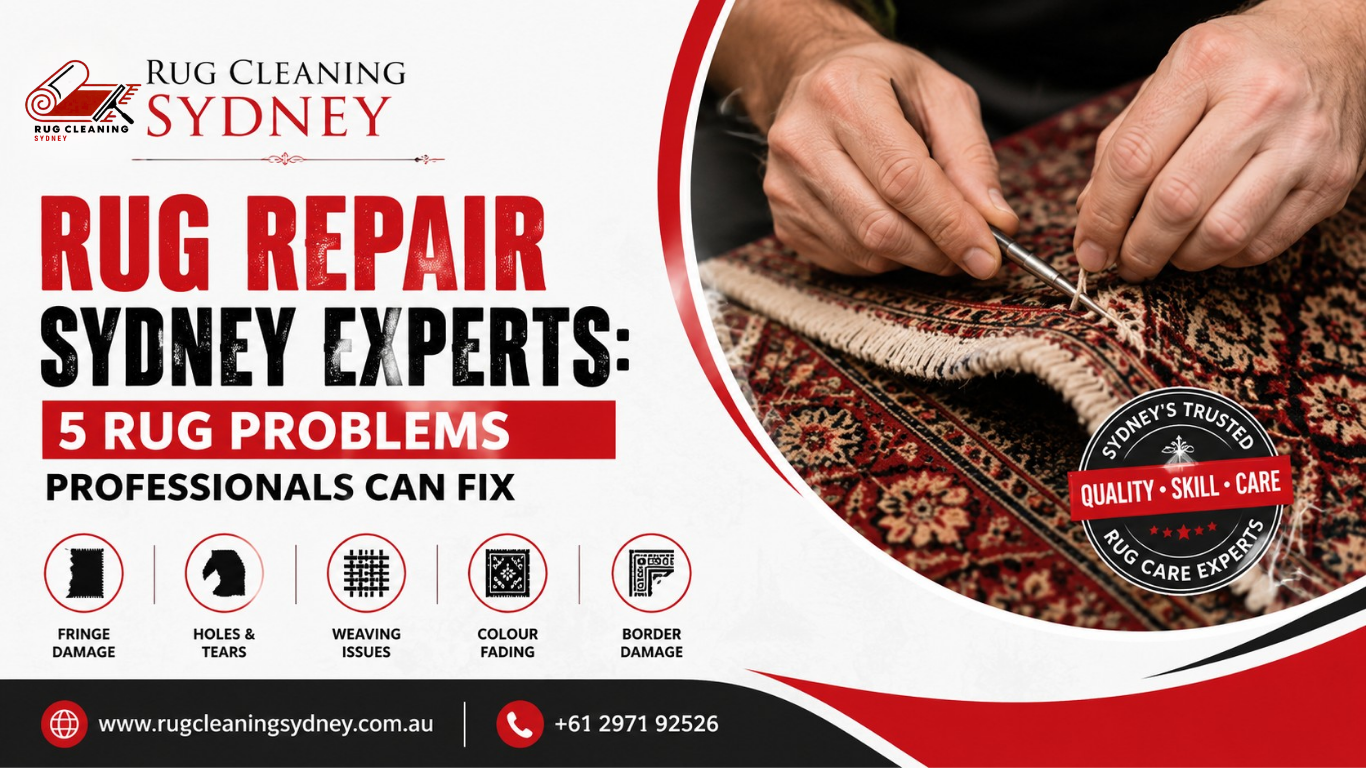
Rug repair Sydney refers to professional restoration services that fix damaged rugs — including fringe loss, holes, moth damage, unravelling edges, and colour fading. Sydney specialists use hand-weaving, re-knotting, and fibre-matching techniques to restore rugs to their original condition. Key providers include Farid Rugs at Drummoyne, NSW.
You noticed it last week. A fringe thread hanging loose. A small hole near the corner. A patch where the pile looks thin and tired. You've been walking past it, hoping it won't get worse.
It will.
Rug damage spreads fast — especially in a city like Sydney where foot traffic, humidity, and even moths can quietly destroy a rug you've had for years. The good news? Most damage is completely fixable when you act early.
This guide covers 5 common rug problems that professional rug repair Sydney specialists can fix — and why attempting DIY on a handmade or wool rug is almost always a mistake.
Table of Contents
1. Fringe Damage — The First Sign of Bigger Trouble
Fringe isn't just decoration. On handmade rugs — Persian, Oriental, Moroccan — the fringe is an extension of the actual warp threads. When it starts breaking or fraying, it means the rug's structural foundation is at risk.
Most Sydney homeowners try to trim the loose threads. This makes things worse. Cutting fringe without securing the foundation causes the pile to unravel inward.
What professional rug repair includes for fringe:
- Securing exposed warp threads with hand-tied knots
- Replacing missing fringe with matched natural fibre
- Overcasting or whipping the rug end to prevent further loss
- Fringe cleaning if discolouration is present
A realistic example: a wool Persian rug with fringe loss on both ends — if left for 12 months, the damage typically spreads 5–8 cm into the pile. Caught early, the entire repair takes a few hours and costs a fraction of full restoration.
If your fringe looks uneven or is missing patches, that's a signal to book a professional inspection before it becomes a larger rug restoration Sydney job.
2. Holes and Tears in the Rug Pile
Holes happen for many reasons — furniture legs left in one spot too long, a burn from a falling ember, a rotted patch from prolonged moisture, or an old pet scratch. Regardless of the cause, a hole in a handmade rug needs professional re-weaving.
How rug re-weaving works
Professional rug re-weaving is painstaking, skilled work. A trained technician matches the original fibre type — wool, silk, cotton, or synthetic — and recreates the knot structure by hand.
For machine-made rugs, repairs are simpler and faster. For hand-knotted rugs, the repair can take days because each knot must match the surrounding pattern precisely.
The key factors that affect the quality of rug hole repair are:
- Accuracy of fibre and colour matching
- Matching the original knot density (KPSI — knots per square inch)
- Pattern alignment across the repaired section
- Finishing the pile to blend seamlessly with existing height
A well-done repair on a Persian rug is practically invisible. A poor one stands out immediately — and can actually reduce the rug's value further.
Professional rug hole repair involves sourcing matching fibre, re-weaving the damaged area using the original knot style, aligning the pattern, and trimming the pile to the correct height. For hand-knotted rugs, this is done entirely by hand and can take several hours to days depending on the size of the damage.
3. Moth Damage and Insect Infestation
This one surprises many Sydney rug owners. Moths don't eat the rug — their larvae do. And they prefer dark, undisturbed areas: under sofas, behind furniture, in storage.
By the time you see visible damage, the infestation is usually well-established. You'll notice thinning pile in patches, a powdery residue underneath, or small cocoon casings in the fibres.
Why moth damage is urgent
Wool rugs are especially vulnerable. Wool moth larvae feed on the keratin protein in natural fibres. A single season of unchecked damage can destroy patches that took a craftsperson weeks to weave.
Professional rug repair for moth damage involves:
- Specialist cleaning to kill all larvae and eggs
- Assessment of structural damage to the foundation
- Re-weaving of eaten pile sections with matched wool
- Moth-deterrent treatment applied after repair
If you store rugs seasonally, always clean them professionally before storage. Moth eggs are microscopic — a visually clean rug can still carry an active infestation into storage.
The team at Rug Cleaning Sydney handles moth treatment as part of a full inspection and restoration service, ensuring the rug is clean, repaired, and protected before it goes back into your home.
Not sure if your rug has moth damage?
Book a free inspection with Sydney's rug repair specialists. We'll assess the damage and give you a no-obligation quote.
4. Unravelling Edges and Binding Failure
The edges of a rug — the sides, not the ends — are wrapped in a protective overcasting called binding or selvedge. On handmade rugs, this is often done with wool or cotton cord. On machine-made rugs, it's usually a serged or glued edge.
When the binding starts to unravel, it's one of the fastest-spreading forms of rug damage. Every step across that edge causes more fibres to loosen. Within weeks, a small unravelling patch can become a torn edge several centimetres wide.
Edge repair methods professionals use
| Rug Type | Edge Repair Method | Typical Timeframe |
|---|---|---|
| Hand-knotted Persian / Oriental | Hand-sewn wool overcasting, colour-matched | 1–3 days |
| Machine-made wool or synthetic | Serging or binding tape application | Same day |
| Flatweave / Kilim | Overcast stitching matching original pattern colour | 1–2 days |
| Antique or silk rugs | Specialist hand-restoration with archival thread | 3–7 days |
If your rug has a loose or completely missing edge binding, avoid using it until it's repaired. The damage accelerates with foot traffic, and in severe cases the weft threads begin to pull away from the body of the rug.
For antique rug restoration in Sydney specifically, edge repairs are often the most critical step in preserving structural integrity. Read more about what that process involves in our guide: Antique Rug Restoration Sydney: Save Your Heirloom Before It's Too Late.
5. Colour Fading and Water Damage Stains
Sun exposure, flooding, or improper at-home cleaning — all of these can cause colour loss in a rug. On Persian and Oriental rugs, colour is often locked into the fibres using natural or vegetable dyes. These are beautiful but sensitive to UV light and harsh chemicals.
Water damage is particularly tricky. If a rug dries while wet for too long — say after a flood or an overenthusiastic mop — the dyes can bleed or leave tide marks. The backing can rot. The pile can shrink unevenly.
Can faded rug colour really be restored?
In many cases, yes — but only by specialists. Professional rug colour restoration involves:
- Identifying the original dye type (natural, synthetic, chrome)
- Spot-matching and applying dye by hand to faded sections
- Full-immersion re-dyeing for rugs with widespread colour loss
- Setting the dye with heat or fixatives to prevent future bleeding
This is not a job for off-the-shelf fabric dye. The colour chemistry of a hand-knotted wool rug is completely different to a cotton curtain. Wrong dyes applied at home often make the problem worse and make professional correction harder.
If your rug has water stains or sun-bleached patches, the earlier you act, the better the result. Many colour issues that are treatable today become permanent within months. You can also explore how we handle stubborn stains and liquid damage as part of our restoration process.
DIY vs Professional Rug Repair: What's at Stake
Here's the honest truth about DIY rug repair: it works on very simple, low-value rugs with minor damage. For anything handmade, antique, wool, or silk — it's a risk not worth taking.
The Institute of Inspection, Cleaning and Restoration Certification (IICRC) recommends professional evaluation for any structural rug damage, because incorrect repair techniques can permanently compromise fibre integrity.
Common DIY mistakes that make damage worse
- Trimming fringe without securing the knot structure
- Gluing down loose pile instead of re-weaving
- Using household carpet tape on antique rug edges
- Applying bleach or commercial stain removers to natural dyes
- Steam-cleaning wool rugs at high heat (causes shrinkage)
Professional rug repair in Sydney typically costs far less than replacing a damaged rug — especially a Persian, Oriental, or handmade piece. A repair that costs $150–$400 can save a rug worth thousands.
Before you decide, it's worth reading our guide on 7 signs you need professional rug help — many of the same indicators apply to repair as well as cleaning.
For a broader understanding of rug materials and why different fibres need different approaches, Wikipedia's overview of carpet and rug construction is a solid reference point.
Your rug deserves expert hands — not guesswork.
Sydney's most trusted rug repair and restoration specialists. 21+ years. Fully insured. Free pickup available.
→ Get a Free Rug Repair Quote TodayOr call us directly: +61 2971 92526
People Also Ask: Rug Repair Sydney
What is rug repair and what does it involve?
Rug repair covers a range of restoration services: fringe replacement, re-weaving of holes, edge binding repair, moth damage treatment, and colour restoration. The process varies depending on the rug type, material, and extent of damage. For handmade rugs, most repairs are done entirely by hand to match the original construction.
What types of rugs can be professionally repaired in Sydney?
Almost all rug types can be repaired professionally — Persian, Oriental, wool, silk, flatweave, Kilim, machine-made, and antique rugs. The repair approach differs by construction type and fibre. Silk and antique rugs require the most specialised care due to their delicate nature.
How much does rug repair cost in Sydney?
Rug repair costs in Sydney vary based on the damage type and rug size. Fringe repair typically starts around $80–$150. Re-weaving a small hole can range from $100–$400. Full edge binding repair runs $100–$300. Colour restoration is priced by area. Most reputable providers offer a free assessment before quoting.
How do I know if my rug needs repair or just cleaning?
If the rug has physical damage — fringe loss, holes, torn edges, thinning pile — it needs repair. If the issue is dirt, stains, odour, or dullness without structural damage, professional cleaning may be enough. In many cases, both are recommended together for best results.
Rug repair vs rug replacement — which is better?
For handmade, Persian, Oriental, wool, or antique rugs, repair is almost always the better choice. Replacement costs far more and you lose an item with both monetary and sentimental value. Machine-made rugs under $200 may not justify the repair cost — a professional can advise after inspection.
What is the best way to find rug repair near me in Sydney?
Look for specialists with verifiable experience in hand-knotted rug repair, not general carpet repairers. Check reviews specifically mentioning Persian, Oriental, or wool rugs. Ensure they offer a free quote and can show before-and-after examples of past work. Farid Rugs at Drummoyne is one of Sydney's long-standing specialists.
Can moth-damaged rugs be fully restored in Sydney?
In most cases, yes — provided the damage is caught before the foundation threads are destroyed. Early-stage moth damage affecting the pile can be re-woven and treated effectively. Severe damage affecting the warp and weft structure is harder to restore but often still repairable. Early action is everything.
FAQ: Rug Repair Sydney
How long does professional rug repair take in Sydney?
Simple repairs like fringe replacement or edge binding can be completed in 1–3 days. Complex re-weaving on hand-knotted or antique rugs may take 1–2 weeks. The turnaround depends on the damage extent and the rug's construction. Most Sydney specialists can give an accurate timeframe after initial inspection.
Do rug repair specialists in Sydney offer pickup and delivery?
Yes. Reputable rug repair Sydney providers typically offer white-glove pickup and delivery. This is especially important for large rugs or fragile antique pieces that are difficult to transport safely. Farid Rugs at Drummoyne offers this service across Sydney.
Can a rug with a torn backing be repaired?
Yes. Backing repair is a common service. Specialists replace or reinforce deteriorated backing using appropriate materials matched to the rug type. For hand-knotted rugs with cotton foundations, this requires specialist knowledge to avoid stressing the pile above.
Is it worth repairing an old or antique rug?
Almost always, yes. Antique rugs typically increase in value with age and proper care. Professional repair preserves both the monetary and heritage value. A well-repaired antique rug is worth significantly more than one with visible unaddressed damage. See our detailed guide on antique rug restoration in Sydney.
Can sun-faded rugs be restored to their original colour?
Many sun-faded rugs can be substantially improved through professional colour restoration. Full restoration depends on how deeply the UV has affected the dye — recent fading responds better than long-term bleaching. Specialist assessment is needed to determine what's achievable before committing to the process.
What should I do if my rug gets water-damaged?
Act within 24–48 hours to prevent mould and dye bleed. Do not fold or roll a wet rug. Lay it flat in a ventilated area and contact a professional rug cleaner and repairer immediately. The faster the response, the better the outcome. Read more about protecting your rugs from damage.
Where is Farid Rugs rug repair located in Sydney?
Farid Rugs is located at 171 Victoria Rd, Drummoyne NSW 2047. They serve clients across the greater Sydney metropolitan area and offer pickup and delivery for rug cleaning and repair. Open Monday to Friday, 9:30 AM to 4:30 PM. Contact: +61 2971 92526.
No comments yet. Be the first!