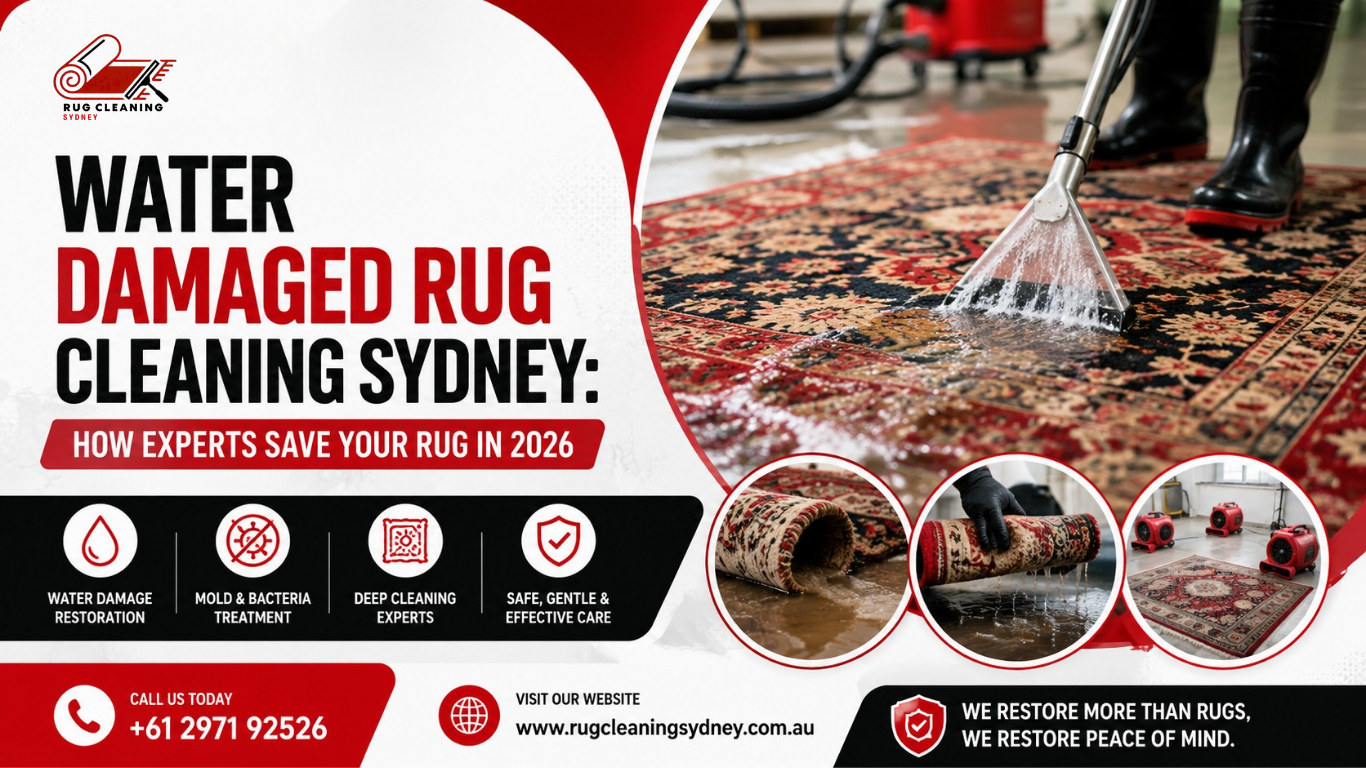
Water damaged rug cleaning Sydney refers to emergency specialist treatment for rugs exposed to floods, leaks, or burst pipes. Key steps include immediate moisture extraction, controlled flat drying, mould treatment, dye-stabilisation, and deodorising. Acting within 24–48 hours prevents permanent mould, shrinkage, and dye bleed on wool, silk, and Persian rugs.
You walked in and found it — your rug, sitting in water. Maybe a pipe burst overnight. Maybe the last storm pushed water under the door. Maybe the washing machine overflowed and soaked straight through.
That sinking feeling is real. Because you know what water does to a good rug. Especially a wool, silk, or handmade Persian. And the clock is already ticking.
Most Sydney homeowners don't know that mould can set into a wet rug within 24 to 48 hours. Or that incorrect drying causes permanent shrinkage. Or that some DIY methods — like leaving it in the sun — actually destroy natural dyes.
This guide covers exactly what expert water damaged rug cleaning in Sydney involves, what you should do right now, and how to tell if your rug can still be saved.
What's In This Guide
Why Water Is So Dangerous for Rugs
A wet rug isn't just a wet rug. Water doesn't sit on the surface — it drives deep into the pile, the foundation threads, and the backing.
For machine-made synthetic rugs, that's annoying. For a handmade wool, silk, or Persian rug, it's a genuine emergency.
Here's what happens when water gets into a natural-fibre rug:
- Mould and mildew begin forming in the pile within 24–48 hours — especially in Sydney's humid climate.
- Dyes bleed — particularly in older Persian and Oriental rugs where vegetable dyes are highly water-reactive.
- Fibres shrink — wool contracts when wet and dried incorrectly, distorting the rug's shape permanently.
- Foundation threads weaken — prolonged moisture rots cotton warp threads, destroying structural integrity.
- Bacteria multiply — especially if the water came from a drain, flood, or pipe that carried contaminants.
The longer you wait, the worse each one of these gets. That's not fear-mongering — that's just what water does to organic fibres over time.
What to Do in the First 48 Hours
Speed matters more than anything else here. The first thing to do is get the rug off the wet floor.
Don't try to clean it yourself. Don't throw it in the dryer. Don't leave it outside in direct sunlight. All three of these cause irreversible damage to handmade and natural-fibre rugs.
Here's what you should actually do:
- Lift the rug off the floor immediately — even if the floor is still wet. The longer it sits in pooled water, the deeper the damage goes.
- Blot excess moisture gently — use clean white towels. Don't rub. Don't press hard. Just absorb what you can.
- Place it flat in a well-ventilated indoor space — not in direct sun, not folded, not draped over a railing.
- Call a specialist immediately — a professional rug cleaner in Sydney can arrange emergency pickup and begin controlled drying at their facility within hours.
Do not attempt full DIY cleaning at this stage. You risk setting mould deeper, bleeding dyes, and warping the foundation. Learn more about why professional rug cleaning matters for delicate rugs.
Rug soaked from a flood or leak? Rug Cleaning Sydney offers emergency pickup across Greater Sydney. The faster you act, the better the outcome.
How Experts Handle Water Damaged Rugs in Sydney
When a water damaged rug arrives at a specialist facility, the process is nothing like regular rug cleaning. It's a restoration process — not a cleaning process!
The steps to professional water damage rug cleaning in Sydney are as follows:
How experts clean water damaged rugs in Sydney: (1) Damage assessment — fibre, dye, and contamination check. (2) Controlled moisture extraction without agitation. (3) Mould treatment and anti-bacterial application. (4) Flat drying in a climate-controlled facility. (5) Full hand-wash with pH-balanced solutions. (6) Dye re-stabilisation where needed. (7) Deodorising and fringe restoration before delivery.
Step 1: Damage Assessment
A trained technician first thoroughly examines the rug. They check the fibre type (wool, silk, cotton, viscose), the dye stability, the level of contamination in the water, and whether mould has already begun to form.
This step determines everything — what treatments are safe, what risks exist, and whether full restoration is possible.
Step 2: Controlled Moisture Extraction
The rug is laid flat and excess water is extracted using specialised equipment — not heat, not a standard extractor. The goal is to remove moisture without agitating fibres or spreading any contamination already present.
Step 3: Mould and Anti-Bacterial Treatment
If mould is present — or if the water came from a contaminated source like a drain or floodwater — the rug undergoes targeted mould treatment. Safe, textile-appropriate anti-bacterial agents are applied across the pile and foundation.
This step is non-negotiable for any rug exposed to Sydney's humidity for more than a few hours.
Step 4: Controlled Flat Drying
This is where most DIY attempts fail. Drying a rug incorrectly — too hot, too fast, or folded — causes shrinkage, pile distortion, and colour shift. Professionals dry rugs flat, at controlled temperature, with airflow managed across both sides.
This usually takes about 12 – 36 hours depending on the type of fibre and thickness of the rug in Sydney's climate.
Step 5: Full Hand-Wash
After the rug is stabilised it is hand washed completely in a pH balanced solution that is designed to not harm fibres. This gets rid of any contamination, odour compounds and dislodged soil that may have been present in the flood or leakage. For more information on how how professional Oriental rug cleaning works in Sydney.
Step 6: Dye Stabilisation and Deodorising
Techniques are used to reduce dye bleed when dye has already migrated, using dye stabilisers. Deodorising treatment removes any lingering odors (especially when the water source is contaminated or the rug is left damp for an extended period of time).
Step 7: Fringe Restoration and Delivery
Fringes are individually cleaned, straightened, and checked. The rug is then returned via white-glove delivery — flat, wrapped, and ready to place back in your home.
Mould and Odor: The Hidden Damage You Can't See
This is the part most people underestimate. A rug can look dry on the surface and still be holding serious moisture in the pile and foundation underneath.
In Sydney's climate — humid, warm, with poor airflow in many apartment blocks and older homes — mould doesn't wait. It grows fast and invisibly. By the time you can smell it, it's already well-established.
Mould in a rug isn't just a smell problem. It:
- Weakens natural fibres at a structural level — wool and silk rot under prolonged mould exposure
- Poses health risks — mould spores affect air quality and can trigger respiratory issues
- Creates staining that becomes permanent if left untreated for more than a few days
DIY mould treatment — bicarbonate of soda, white vinegar, surface sprays — doesn't reach deep into rug foundations. It treats the surface and leaves the problem underneath.
Professional rug mould removal in Sydney involves targeted anti-fungal treatment, full submersion cleaning, and the controlled drying cycle that actually eliminates the source — not just the smell.
For context on how professional services approach restoration, see how rug repair Sydney specialists handle structural damage.
Which Rug Types Are Most at Risk
Not all rugs respond to water damage the same way. The risk level depends heavily on fibre type and construction.
| Rug Type | Risk Level | Key Concern |
|---|---|---|
| Hand-knotted Persian / Oriental | Very High | Dye bleed, foundation rot, fringe damage |
| Wool | High | Shrinkage, mould, pile distortion |
| Silk | Very High | Fibre breakdown, permanent dye shift |
| Cotton flatweave | Medium | Mould, colour migration |
| Viscose / Bamboo silk | Very High | Irreversible pile collapse and browning |
| Synthetic (polypropylene) | Low–Medium | Backing mould, odour retention |
| Antique / Heirloom | Extreme | Fragile construction amplifies all risks |
Viscose is particularly vulnerable — even short-term moisture contact causes the pile to collapse and brown. This damage is often irreversible without professional intervention within hours.
Don't wait to see if it dries out on its own. The longer a wet rug sits, the harder — and more expensive — the restoration becomes.
Book Emergency Rug Pickup in Sydney — Call +61 2971 92526Can Your Rug Be Saved? How Experts Assess the Damage
This is the question everyone with a water damaged rug wants answered. The honest answer is: it depends on how quickly you act and what kind of water caused the damage.
Here's how specialists categorise water damage when they assess a rug:
Category 1 — Clean Water (Burst Pipe, Tap Overflow)
Best-case scenario. Clean water causes moisture damage but no contamination. Most rugs treated within 24–48 hours can be fully restored.
Category 2 — Grey Water (Washing Machine Overflow, Minor Flooding)
Contains some contamination. Requires anti-bacterial treatment as part of the cleaning process. Full restoration is still achievable for most rugs if treated promptly.
Category 3 — Black Water (Stormwater Flood, Sewage)
Highly contaminated. Poses genuine health risks. Some rugs — particularly those with porous natural foundations that have absorbed significant contamination — may be unrestorable. Specialists assess on a case-by-case basis.
Beyond water category, the other factors that affect restorability:
- Time elapsed since the damage — hours versus days is a massive difference
- Whether mould has already formed deep in the foundation
- Whether dye bleed has migrated across adjacent colours
- Whether the rug was stored wet or folded while damp
Rug Cleaning Sydney offers a free no-obligation inspection before any work begins. If your rug can't be saved, they'll tell you honestly — before charging you anything. For high-value rugs, you can also explore expert Persian rug cleaning Sydney services that handle complex restoration cases.
People Also Ask: Water Damaged Rug Cleaning Sydney
What is water damaged rug cleaning?
Water damaged rug cleaning is a specialist restoration process for rugs exposed to floods, leaks, or burst pipes. It goes beyond regular cleaning to include moisture extraction, mould treatment, controlled drying, dye stabilisation, and deodorising — all adapted to the specific fibre and construction of the rug.
What causes the most damage to a rug after it gets wet?
The biggest damage factors are time and heat. Mould forms within 24–48 hours in Sydney's climate. Heat — from sun exposure or a dryer — causes wool to shrink and dyes to shift permanently. Acting fast and avoiding heat is the most critical thing you can do before a professional takes over.
How do you dry a water damaged rug without causing more damage?
The safe approach is controlled flat drying in a climate-managed indoor space with good airflow — never in direct sun, never folded, never in a dryer. For handmade or natural-fibre rugs, professional facilities in Sydney use temperature-controlled drying rooms designed specifically for rugs. Home drying works for synthetic rugs only.
How long does professional water damaged rug cleaning take in Sydney?
Most water damaged rugs take 3–7 days from pickup to delivery, depending on severity of damage, rug thickness, and whether mould treatment or dye stabilisation is required. Emergency pickup is typically available same-day or next-day across Greater Sydney.
DIY vs professional: which is better for a flood-damaged rug?
DIY is appropriate only for small synthetic rugs with clean water damage. For wool, silk, Persian, or any handmade rug — professional treatment is essential. DIY methods can't reach deep mould in foundations, can't control drying temperature, and often cause more damage (shrinkage, dye bleed, pile collapse) than the original flood.
What is the best way to remove mould from a water damaged rug in Sydney?
Professional anti-fungal treatment combined with full submersion washing and controlled drying is the only reliable method. Surface treatments — vinegar, bicarbonate of soda, commercial sprays — don't penetrate deep into rug foundations and leave the root problem untreated, especially in Sydney's humid conditions.
Is it worth cleaning a water damaged rug, or should I replace it?
For machine-made synthetic rugs of low value, replacement may be the practical choice if damage is severe. For any handmade, wool, silk, Persian, or antique rug — professional restoration almost always costs less than replacement. A good specialist will assess your rug honestly before charging for any work.
Frequently Asked Questions
Does Rug Cleaning Sydney offer emergency pickup for water damaged rugs?
Yes. Emergency same-day and next-day pickup is available across Greater Sydney. The sooner you call after the damage occurs, the better the restoration outcome. Contact them at +61 2971 92526.
How much does water damaged rug cleaning cost in Sydney?
Cost depends on rug size, fibre type, damage severity, and whether mould treatment or dye restoration is required. Most specialists offer a free inspection before quoting — so you know exactly what's involved before committing.
Can a rug shrink from water damage?
Yes — particularly wool rugs. Wool fibres contract when exposed to water and then dried at high heat or too quickly. Professional controlled flat-drying prevents shrinkage. This is one of the main reasons DIY drying of wool rugs often makes things worse.
Will the colours run if my rug gets wet?
It depends on the dyes. Older Persian and Oriental rugs with natural vegetable dyes are highly susceptible to dye bleed when wet. Synthetic dyes in modern rugs are more stable. A specialist applies dye stabilisers as part of the restoration process to halt and control any migration.
Is it safe to use a water damaged rug after cleaning?
Yes, once fully restored by a professional. The rug will have been treated for bacteria, mould, and contamination — and fully dried and deodorised. It is safe to return to your home just as it was before the damage.
What if my rug was soaked in floodwater from heavy rain?
Stormwater and floodwater is classified as black water — contaminated water that carries bacteria, debris, and pollutants. Your rug requires anti-bacterial treatment in addition to restoration. Don't handle it without gloves, and call a specialist as soon as possible.
Does home insurance cover water damaged rug cleaning in Sydney?
Many home and contents insurance policies in Australia cover rug damage from sudden and accidental water events — burst pipes, appliance overflow, or storm flooding. Check your policy and ask your specialist for a detailed treatment report for your insurer.
No comments yet. Be the first!