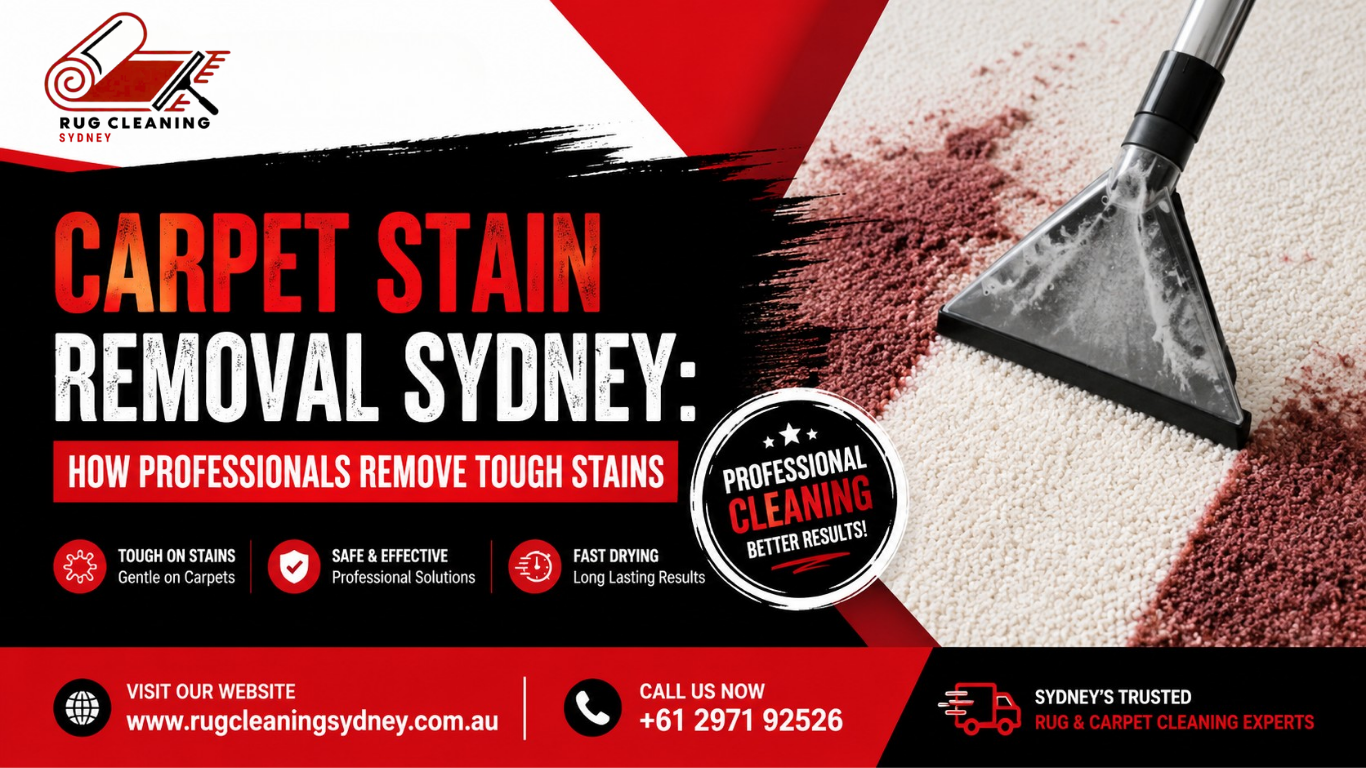
Professional carpet stain removal in Sydney uses a multi-stage process: pre-inspection to identify fibre type and stain chemistry, targeted pre-treatment with enzyme or solvent solutions, hot water extraction, and post-treatment for residual odour. Common tough stains — red wine, pet urine, coffee, grease, and blood — each require different chemistry. DIY scrubbing typically sets stains deeper; professional treatment reverses damage that home products cannot.
Published: June 2026 | Category: Carpet Care Tips | Author: Rug Cleaning Sydney Team
You've tried everything. The supermarket spray. The baking soda method you found online. The rental machine from the hardware store. The stain is still there — maybe lighter, maybe just different.
This is the most common story we hear from Sydney homeowners who call us. And the frustrating truth is that DIY attempts, even well-intentioned ones, often make professional removal harder by pushing the stain deeper into the backing or partially setting it with the wrong pH chemistry.
This guide explains exactly what professional carpet stain removal involves — the actual process, the chemistry, the stain-by-stain breakdown — so you understand why it works when home methods don't.
Table of Contents
Why DIY Stain Removal Usually Makes Things Worse
Most carpet stain removal products sold in Australian supermarkets are designed for immediate, surface-level spills on synthetic fibres. They work adequately on a fresh coffee spill on polypropylene carpet. They fail — or actively cause damage — in almost every other scenario.
Here's what goes wrong with DIY approaches:
Wrong chemistry for the stain type
Stains fall into two broad categories: acid-based (wine, coffee, fruit juice) and alkaline-based (pet urine as it oxidises, some food stains). Using the wrong pH treatment on a stain can chemically bond it to the fibre rather than lifting it. Many commercial sprays are alkaline — fine for some stains, damaging for others.
Rubbing instead of blotting
The instinct when you see a stain is to scrub. Scrubbing pushes the stain horizontally through the pile, spreads it into a larger area, and drives it deeper into the carpet backing. Professional removal always works from the outside inward, using controlled blotting pressure.
Over-wetting the backing
Pouring liquid on a carpet stain saturates the backing and underlay. In Sydney's humid climate this creates a mould risk — particularly in summer months — and can cause permanent delamination of carpet backing layers.
Leaving residue
Most DIY products leave a chemical residue in the carpet pile that acts like a dirt magnet. The stain appears to disappear, then comes back darker within days as the residue attracts new soiling. This is called "wicking" — and it's one of the most common complaints we receive from homeowners who've attempted their own treatment first.
⚠️ Important: Never use bleach, undiluted white vinegar, or hydrogen peroxide on wool or natural fibre carpets. These chemicals permanently damage wool fibres and strip natural dyes. If you have a wool or Persian rug with a stain, blot immediately and call a professional — do not apply any product.
The Professional Carpet Stain Removal Process
Professional carpet stain removal is not one product applied to a stain. It's a structured, chemistry-informed process that varies by stain type, fibre, and how long the stain has been set.
Stage 1 — Pre-inspection
Before any product is applied, a qualified technician identifies: the carpet fibre type (wool, synthetic, nylon, polypropylene, or blended), the construction method (cut pile, loop pile, flatweave), the stain type and approximate age, and whether any previous treatment has been applied. Each of these factors changes the approach.
Stage 2 — Pre-vacuuming
Dry soil is removed before any liquid treatment. Applying moisture to dry soil creates mud that pushes deeper into fibres — pre-vacuuming prevents this and is skipped by many DIY attempts.
Stage 3 — Targeted pre-treatment
The correct chemistry is selected for the specific stain:
- Enzyme-based solutions — for protein stains (blood, pet urine, food)
- Oxidising agents — for tannin-based stains (coffee, tea, red wine)
- Solvent-based treatments — for oil and grease stains
- Acidic treatments — for alkaline residue stains (cement, some cleaning products)
The pre-treatment is applied to the stain and given a dwell time — typically 5–15 minutes — to break down the molecular bond between the stain and the fibre.
Stage 4 — Agitation
A soft brush or grooming tool is used to work the pre-treatment into the stain with controlled, inward-only strokes. This is fundamentally different from the scrubbing motion used in DIY attempts.
Stage 5 — Hot water extraction
Professional hot water extraction equipment forces heated water under pressure into the carpet pile, then immediately extracts it along with the loosened stain material, treatment chemicals, and soil. Commercial extraction machines operate at significantly higher suction and heat than any rental unit.
Professional carpet stain removal follows five stages: pre-inspection (fibre and stain identification), dry vacuuming, targeted pre-treatment with chemistry matched to the stain type (enzyme for protein stains, oxidising agents for tannin stains, solvents for grease), controlled agitation, and hot water extraction. Post-treatment neutralisation and deodorising follow for persistent stains. The full process typically takes 30–90 minutes per room.
Stage 6 — Post-treatment and pH neutralisation
After extraction, the treated area is rinsed with a pH-neutral solution to remove any treatment residue. This step prevents the dirt-magnetising residue problem that plagues DIY cleaning. For pet stains, an enzyme deodouriser is applied after extraction to break down odour-causing uric acid crystals at the molecular level.
Stage 7 — Drying
Industrial air movers are used to accelerate drying. In Sydney's humid climate this step is not optional — dampness left in carpet backing leads to mould growth within 24–48 hours in summer conditions.
Stain-by-Stain: How Professionals Treat Each Type
Different stains require fundamentally different chemistry. Here's the professional approach to the most common carpet stains in Sydney homes:
Red Wine & Rosé
Tannin-based stain requiring an oxidising pre-treatment to break the chromophore (colour molecule). Fresh stains respond extremely well. Stains older than 24–48 hours are significantly harder — the tannins cross-link with wool or nylon fibres. Professionals often achieve full removal on fresh stains; partial on set stains.
Pet Urine & Faeces
The most technically complex stain. Fresh urine is acidic but oxidises to alkaline as it dries — requiring pH adjustment at different treatment stages. Uric acid crystals bind to fibres and reactivate with humidity. Professional enzyme treatment breaks down the crystals. UV light is used to locate all affected areas, including sub-surface wicking invisible to the eye.
Coffee, Tea & Fruit Juice
Tannin and sugar-based stains. Heat from home steam cleaners or hot water sets these permanently by caramelising the sugar component. Professional treatment uses warm (not hot) water with an oxidising agent, followed by extraction. Old, heat-set coffee stains may be partially permanent.
Cooking Grease & Oil
Lipid-based stains that water alone cannot lift. Professionals apply a solvent pre-treatment that dissolves the fat molecules, followed by a water-based detergent solution, then extraction. A critical step most DIY approaches miss is the rinse cycle — grease left in fibres with soap residue creates a sticky magnet for future soiling.
Blood
Protein stain that is permanently set by heat — never use hot water on blood. Professionals use cold water with an enzyme pre-treatment that breaks down haemoglobin. Fresh blood typically achieves full removal. Dried blood requires longer enzyme dwell time and may leave a faint residual shadow on lighter carpets.
Ink, Dye & Nail Polish
Among the hardest stains to remove. Professionals use solvent-based treatments matched to the specific dye class. Ballpoint ink responds differently to permanent marker, which differs from acrylic paint. Results vary significantly by fibre type — synthetic carpets respond better than natural fibres. Partial removal is common; full removal is not guaranteed.
| Stain Type | Professional Method | Removal Success Rate* | DIY Success Rate* |
|---|---|---|---|
| Red wine (fresh) | Oxidising pre-treatment + HWE | 90–95% | 40–60% |
| Red wine (set, 48h+) | Oxidising treatment + agitation | 50–70% | 10–20% |
| Pet urine (fresh) | Enzyme treatment + HWE + deodorise | 95–99% | 30–50% |
| Pet urine (old/set) | UV mapping + multi-stage enzyme | 70–85% | 5–15% |
| Coffee (fresh) | Oxidising agent + extraction | 90–95% | 50–70% |
| Grease/oil | Solvent + detergent + extraction | 85–95% | 20–40% |
| Blood (fresh) | Cold enzyme treatment | 95%+ | 60–75% |
| Ink/permanent marker | Solvent match + extraction | 50–80% | 5–20% |
*Success rates are estimates based on industry standards. Results vary by fibre type, stain age, and previous treatment history.
Got a tough stain that home products haven't shifted?
Rug Cleaning Sydney handles all stain types across wool, synthetic, and natural fibre carpets. Get a free stain assessment →
Why Carpet Fibre Type Changes Everything
The biggest variable in stain removal is not the stain itself — it's the carpet fibre. The same stain, treated with the same product, produces completely different results on wool versus polypropylene versus nylon.
| Fibre Type | Stain Resistance | Treatment Sensitivity | Professional Notes |
|---|---|---|---|
| Wool | Moderate (natural lanolin helps initially) | High — no bleach, no high pH, no heat | Most forgiving for professionals; most dangerous for DIY |
| Nylon | Good (solution-dyed nylon is excellent) | Low-moderate — tolerates most treatments | Best fibre for stain removal outcomes overall |
| Polypropylene | Excellent for surface spills | Low — handles most treatments | Easy to clean but shows pile distortion under pressure |
| Polyester | Good initially; poor after compression | Low-moderate | Oil-based stains are particularly stubborn |
| Natural (jute/sisal) | Very poor — absorbs moisture rapidly | Very high — water causes shrinkage and mould | Requires specialist dry-treatment approach |
This is why professional pre-inspection is not a formality. Applying an alkaline oxidising treatment to a wool carpet can cause irreversible colour change. Applying high heat to a polypropylene carpet can cause pile distortion that cannot be reversed. The chemistry must match the fibre.
For handmade rugs — Persian, Oriental, Turkish, Afghan — the stakes are even higher. Natural dyes used in traditional rug-making are water-soluble and can bleed catastrophically with incorrect treatment. See our Persian rug cleaning guide for how specialist care differs from standard carpet cleaning.
What Stains Cannot Be Fully Removed
Honest answer: some stains can't be fully removed. Any carpet cleaner who guarantees complete removal of every stain is overpromising. Here's what genuinely limits professional stain removal:
- Bleach and chemical burns — These destroy the dye in carpet fibres permanently. No cleaning process can restore colour. Bleach spots can be repaired through re-dyeing or patch replacement, but the stain itself cannot be "removed".
- Old, heat-set stains — Any stain that has been treated with hot water or a hot steam cleaner at home may have undergone a chemical change that bonds it permanently to the fibre. Coffee, juice, and some food stains are particularly vulnerable to this.
- Prolonged pet urine damage — If pet urine has been present for months and has penetrated through carpet, backing, and into the underlay or subfloor, the odour source is no longer in the carpet. In this case, the underlay must be replaced and the subfloor treated before a clean is meaningful.
- Rust and metalite stains — Iron oxide bonds aggressively with carpet fibres, especially natural ones. Professional products exist but results are inconsistent. Rust stains on lighter carpets are often permanent.
- Permanent marker and acrylic paint (dried) — Once dry, these form a hard polymer film within the fibre structure. Solvent treatment may reduce but rarely eliminates these stains.
For situations where the stain itself cannot be removed, the alternative is professional rug repair and restoration — including patch replacement, re-tufting, or colour correction. These options are more viable than most homeowners realise.
First-Aid Steps Before the Professionals Arrive
What you do in the first five minutes after a spill has a significant impact on professional removal success. Here's the correct first-response protocol for Sydney homeowners:
- Blot immediately — Use a clean white cloth or white paper towel. Press firmly and lift straight up. Never rub or scrub.
- Work from the outside inward — This prevents spreading the stain to clean carpet.
- Remove solid matter first — For food, pet faeces, or mud, remove as much solid material as possible with a blunt knife or spoon before applying any liquid.
- Use cold water only — Cold water dilutes most stains without setting them. Warm or hot water sets protein stains (blood, egg, dairy) permanently.
- Do not over-wet — Apply water sparingly with a cloth, not by pouring. Excess moisture reaches the backing and creates mould risk.
- Do not apply products to wool or natural fibre rugs — Blot only, then call a professional as soon as possible.
- Note the stain type — Tell your technician what the stain is, when it occurred, and whether any product has been applied. This information directly affects the treatment approach.
If you're in Sydney's Eastern Suburbs, Inner West, North Shore, or anywhere else across the metro area, Rug Cleaning Sydney offers same-week stain treatment bookings. Early treatment dramatically improves removal outcomes — every day a stain sits increases the likelihood that it becomes permanent.
Stain won't shift? Don't let it set any longer.
Sydney's specialist carpet and rug cleaners — all stain types, all fibre types, all Sydney suburbs.
Book a Professional Stain Treatment Now →📞 +61 2971 92526 | 171 Victoria Rd, Drummoyne NSW 2047 | Mon–Sat 10am–6pm
People Also Ask
What is professional carpet stain removal and how does it work?
Professional carpet stain removal is a multi-stage process that matches cleaning chemistry to the specific stain type and carpet fibre. It involves pre-inspection, dry vacuuming, targeted pre-treatment (enzyme, oxidising, or solvent-based depending on the stain), controlled agitation, hot water extraction, pH neutralisation, and drying. The process is fundamentally different from DIY methods because the chemistry is matched to both the stain and the fibre.
Can professionals remove old carpet stains in Sydney?
Yes — many old stains that appear permanent can be significantly reduced or fully removed by professionals, depending on the stain type and fibre. Set pet urine, old coffee, and grease stains respond well to professional enzyme and solvent treatments. The exceptions are bleach burns, heat-set stains from improper DIY treatment, and prolonged pet urine that has damaged the underlay and subfloor.
How much does professional carpet stain removal cost in Sydney?
Stain-specific treatment in Sydney typically costs $80–$200 per stain depending on size and complexity, often applied as part of a broader carpet clean. A full professional carpet clean including stain treatment for a standard room runs $150–$300 in 2026. The cost of a professional clean is typically a fraction of what early carpet replacement would cost.
Does professional carpet cleaning remove pet urine smell?
Yes, when performed correctly. Professional enzyme treatment breaks down the uric acid crystals in pet urine — which are the source of the persistent odour that surface cleaning cannot eliminate. Old or deep-set urine that has reached the underlay may require underlay replacement for full odour elimination. UV light mapping is used to identify all affected areas, including sub-surface wicking.
What is the best way to remove red wine from carpet?
Blot immediately with a clean white cloth — never rub. Apply cold water sparingly and continue blotting. Do not use hot water or heat. For professional removal, oxidising pre-treatment followed by hot water extraction is the most effective approach. Fresh red wine stains are highly removable professionally; stains older than 24–48 hours become progressively harder to fully remove.
How long does carpet stain removal take to dry in Sydney?
With professional hot water extraction, treated areas typically dry in 4–8 hours. Sydney's summer humidity (above 70% in the December–March period) can extend drying to 12 hours. Industrial air movers are used by professional cleaners to accelerate drying. Keeping windows open and fans running significantly helps. Avoid walking on treated areas until fully dry.
Can you remove carpet stains from wool carpet?
Yes — with specialist treatment. Wool is actually more forgiving than synthetic fibre when treated correctly because its natural lanolin coating initially resists stain penetration. However, wool is very sensitive to incorrect chemistry — alkaline products, bleach, and heat all cause irreversible damage. Always use a specialist who identifies the carpet as wool before applying any product. DIY stain removal on wool rugs carries significant risk of permanent damage.
Frequently Asked Questions
How do I know if my carpet stain is removable?
The main factors are: stain age (fresh stains are almost always more treatable), fibre type (synthetic fibres tolerate more aggressive treatment), and whether heat or incorrect chemicals have been applied previously. The best way to know is a professional pre-inspection — most reputable Sydney cleaners will assess stain treatability before committing to a service.
Is carpet stain removal different from general carpet cleaning?
Yes. General carpet cleaning removes embedded soil, allergens, and light surface staining across the whole carpet. Stain removal is a targeted treatment applied to specific spots using chemistry matched to the stain type. For best results, targeted stain treatment and general cleaning are done in combination — stain pre-treatment first, general clean second.
Can professional stain treatment damage my carpet?
When performed by qualified technicians using correct chemistry for the fibre type, professional stain removal does not damage carpets. The risk of damage comes from DIY attempts using incorrect products — particularly bleach, high-pH cleaners, or heat on wool or natural fibre carpets. This is why pre-inspection and fibre identification are essential first steps.
How soon after a spill should I call a professional?
As soon as possible after your own first-response blotting. Within the first 24 hours gives the best outcome for most stain types. Red wine, pet urine, and coffee stains all increase in difficulty every hour they remain untreated. Blood must be treated before it dries. Some stains — ink, nail polish — benefit from immediate professional treatment rather than any home attempt.
Does Rug Cleaning Sydney provide carpet stain removal for rental properties?
Yes. We provide stain treatment and full carpet cleaning for rental properties across Sydney — including end-of-lease cleans that meet NSW Fair Trading cleanliness standards. We provide documentation of the clean, which landlords and property managers can use as evidence for bond processing. Call +61 2971 92526 to discuss rental property requirements.
What Sydney suburbs do you service for carpet stain removal?
We service all Sydney metro suburbs including the Eastern Suburbs (Bondi, Randwick, Coogee), Inner West (Newtown, Balmain, Leichhardt), North Shore (Chatswood, Mosman, Neutral Bay), Northern Beaches (Manly, Dee Why, Freshwater), South Sydney, and the Hills District. Pickup and return is available for rugs; in-home carpet treatment is available across the metro.
Do you use eco-friendly products for carpet stain removal?
Yes. Rug Cleaning Sydney uses plant-based, biodegradable pre-treatment and cleaning solutions that are free from harsh solvents, phosphates, and synthetic fragrances. Our products are certified safe for children and pets. For more detail on our eco approach, see our eco-friendly carpet cleaning guide.
No comments yet. Be the first!