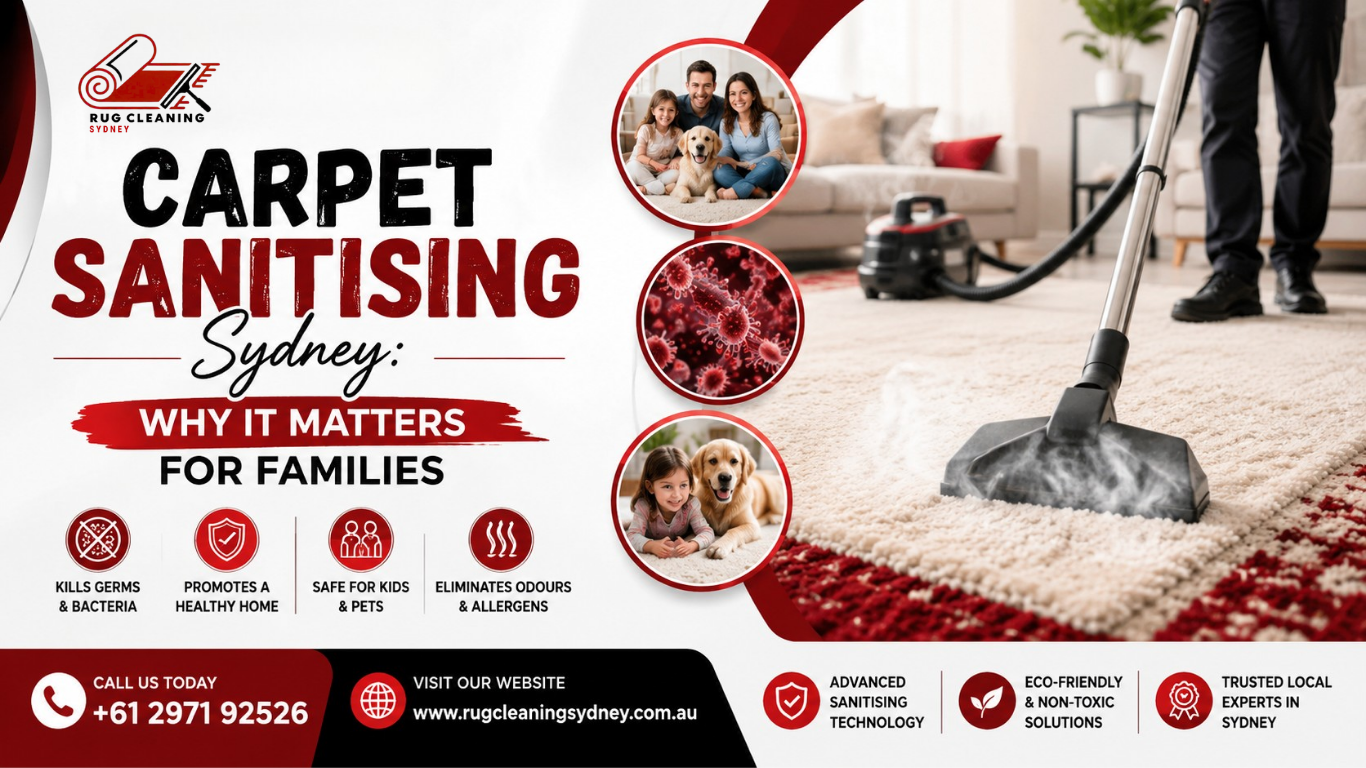
Carpet sanitising in Sydney refers to a professional treatment that kills bacteria, dust mites, allergens, and pathogens living deep inside carpet fibres — beyond what vacuuming or standard cleaning can reach. Key steps include antimicrobial solution application, hot water extraction, and deodorising. It is especially important for families with young children, pets, or allergy sufferers in Sydney's humid climate.
Your carpet looks clean. But what's actually living inside it?
Australian studies have found that the average household carpet can harbour up to 200,000 bacteria per square inch — far more than a typical toilet seat. In Sydney's warm, humid climate, those numbers climb even higher. Dust mites, mould spores, pet dander, and tracked-in bacteria thrive in carpet fibres year-round.
For families with babies crawling on the floor, kids playing at ground level, or anyone with asthma or allergies — that's not just unpleasant. It's a real health concern.
This guide explains exactly what carpet sanitising is, why it's different from standard cleaning, what it costs in Sydney, and how to find a service that actually delivers results for your family.
What Is Carpet Sanitising — and How Is It Different from Cleaning?
Most people use "cleaning" and "sanitising" interchangeably. They're not the same thing.
Carpet cleaning removes visible dirt, stains, and surface debris. Hot water extraction pulls out embedded grit and grime. The carpet looks clean and smells better. That's the goal — and it's valuable.
Carpet sanitising goes further. It uses antimicrobial solutions — sometimes combined with steam treatment — to kill biological contaminants at a microbial level. This includes:
- Bacteria (E. coli, Staph, Salmonella from tracked-in sources)
- Dust mites and their waste particles (a leading allergen trigger)
- Mould and mildew spores (particularly relevant in humid Sydney summers)
- Pet urine bacteria and odour-causing microbes
- Viruses and pathogens in high-traffic areas
What is carpet sanitising?
Carpet sanitising is a professional treatment that eliminates bacteria, dust mites, allergens, mould spores, and pathogens living inside carpet fibres. Unlike standard cleaning, it uses antimicrobial agents and steam to disinfect at a biological level — not just remove surface dirt. It is particularly recommended for homes with children, pets, or allergy sufferers.
Think of it this way: cleaning removes what you can see. Sanitising deals with what you can't. Both matter — but for families, sanitising is the step most providers skip unless you ask for it specifically.
Why Carpet Sanitising Matters for Sydney Families
This isn't about being overly cautious. There are specific reasons why Sydney households — particularly those with young children — face a higher-than-average exposure risk from unsanitised carpets.
Children Spend More Time at Floor Level
Babies and toddlers crawl, sit, and play directly on carpet for hours every day. Their immune systems are still developing. They're also far more likely to put their hands — and whatever's on them — directly into their mouths. A carpet harbouring bacteria from shoes, pets, or outdoor soil isn't just a hygiene issue. It's a direct exposure pathway.
Sydney's Humidity Creates Ideal Conditions for Mould and Dust Mites
Sydney averages relative humidity between 60–80% for much of the year. Dust mites thrive above 50% humidity. Mould spores settle and grow in carpet backing when moisture isn't fully extracted after cleaning. Without periodic sanitising, both multiply quietly — and the health effects build up over time, particularly for asthma and eczema sufferers.
Pet Households Carry Compounding Bacteria Risk
Dogs and cats track in outdoor bacteria on every paw, every time they come inside. Pet urine — even when cleaned up quickly — leaves bacterial residue in carpet backing that odour removers don't fully address. Pet dander is also one of the most common household allergen triggers in Australia.
Shoes Bring in More Than Dirt
Research from the University of Arizona found that the average shoe sole carries around 421,000 units of bacteria — including organisms associated with gut infections and respiratory illness. In households where shoes are worn indoors (still common in many Sydney homes), carpets become the primary collection point.
Regular professional cleaning handles the visible side of this. Sanitising handles the biological side — and for families, both matter.
What's Actually Living in Your Carpet Right Now
It helps to be specific. Here's a realistic breakdown of what professional carpet sanitising targets — and why each one matters for family health.
| Contaminant | Where It Comes From | Health Risk |
|---|---|---|
| Dust Mites | Human skin cells (food source), humidity | Asthma triggers, eczema flare-ups, rhinitis |
| Mould Spores | Moisture trapped in carpet backing | Respiratory irritation, allergy reactions |
| Bacteria (E. coli, Staph) | Shoes, pets, food spills, outdoor tracking | Skin infections, gastrointestinal illness |
| Pet Dander | Cats, dogs — shed continuously | Allergic rhinitis, asthma, eye irritation |
| Pet Urine Bacteria | Accidents, incomplete surface cleaning | Persistent odour, bacterial exposure risk |
| Volatile Organic Compounds (VOCs) | Cleaning product residues, off-gassing | Headaches, nausea, long-term air quality issues |
| Pollen & Outdoor Allergens | Windows, clothing, shoes | Hay fever, asthma exacerbation |
The Australasian Society of Clinical Immunology and Allergy (ASCIA) identifies dust mites and mould as two of the most significant indoor allergen triggers in Australian homes. Both are directly addressable through professional carpet sanitising.
How Professional Carpet Sanitising Works in Sydney
A proper carpet sanitising service in Sydney isn't just a spray-and-go job. Here's what the process looks like when done correctly.
Step 1: Pre-Inspection
The technician inspects the carpet type, coverage, and problem areas are visible (stains, pet area, high traffic areas etc.). This will help you know which type of sanitising agents are safe for your carpet fibres.
Step 2: Pre-Vacuum
A good dry vacuum will pick up loose debris, hair or surface dust prior to the wet treatment. If this step is omitted the sanitising agents will not be as effective, since they are not reaching the fibres but they are working through the dirt on the surface.
Step 3: Pre-Treatment of Problem Zones
Any areas where pets have urinated, high-bacteria areas (entry points, play areas) or visible staining are treated before the treatment to neutralize the bacteria. These are used to decompose organics prior to the bulk extraction.
Step 4: Antimicrobial Sanitising Agent Application
A hospital-grade or EPA/TGA-registered antimicrobial solution is applied across the full carpet. This is the step that separates sanitising from standard cleaning. The solution dwells for several minutes to penetrate fibres and kill biological contaminants at source.
Step 5: Hot Water Extraction
High-pressure hot water — typically at 90°C+ from truck-mounted equipment — flushes through the carpet, activating the sanitising agents and extracting dissolved contaminants, dead microbes, allergens, and residue. The heat alone kills most dust mites and mould spores.
Step 6: Deodorising Treatment
A neutralising deodoriser is applied to address any residual odours. Child-safe and pet-safe formulations are standard with reputable Sydney providers — always confirm this when booking.
Step 7: Speed-Drying
Air movers or high-velocity fans reduce drying time to 2–4 hours. This matters for sanitising specifically — carpets left damp too long risk reintroducing the mould conditions you just treated.
If your home also has rugs — wool, Persian, or silk pieces — these require a completely different sanitising approach. Read more about how Sydney experts protect and deep-clean delicate rugs to understand why specialist care matters for those pieces.
Want to know exactly what your carpets need? Book a free carpet health assessment with Rug Cleaning Sydney — no pressure, no hidden costs.
Carpet Sanitising Costs in Sydney: 2026 Price Guide
Sanitising is typically offered as an add-on to standard carpet cleaning, or as a standalone service. Here's what you can expect to pay across Greater Sydney in 2026.
| Service | Price Range | Notes |
|---|---|---|
| Sanitising add-on (per room) | $15 – $35 | Added to standard carpet cleaning booking |
| Full sanitising treatment (3-bed home) | $180 – $320 | Includes cleaning + antimicrobial treatment |
| Pet odour + bacteria treatment | $40 – $80 per area | Enzyme pre-treatment + sanitising |
| Dust mite treatment only | $20 – $40 per room | Often combined with allergen-reduction clean |
| Deodorising add-on | $10 – $25 per room | Applied after sanitising treatment |
| Commercial sanitising (per sqm) | $1.50 – $3.50 | Offices, childcare centres, medical premises |
Most Sydney families find that bundling standard carpet cleaning with a sanitising treatment in a single visit gives the best value. Separate call-outs for sanitising alone typically carry a $80–$100 minimum fee.
Childcare centres, schools, and medical practices in Sydney often require commercial-grade carpet sanitising under WHS compliance obligations. For a detailed look at how those services work, read our guide on commercial carpet cleaning in Sydney.
How Often Should Sydney Families Sanitise Their Carpets?
There's no single answer — it depends on your household. But here are useful benchmarks.
Every 6 Months
Recommended for homes with: babies or toddlers who spend significant time on the floor, one or more pets that come indoors, anyone with diagnosed asthma, eczema, or dust mite allergy, or households where shoes are regularly worn inside.
Every 12 Months
Standard for homes with older children, no pets, and no known allergy issues. Combine with an annual deep clean for best results.
After Specific Events
Sanitising is particularly worthwhile after: a household member has been ill with a contagious infection, a pet accident that soaked through to carpet backing, flooding or significant moisture exposure, moving into a rental property (you don't know what the previous occupants left behind), or post-renovation if carpet was exposed to construction dust and debris.
According to Healthdirect Australia, indoor allergen management — including regular cleaning and sanitising of soft furnishings — is a key recommendation for households with asthma sufferers, particularly for children under 12.
How to Choose the Right Carpet Sanitising Service in Sydney
Not every carpet cleaning company in Sydney actually offers true sanitising. Some providers use the word loosely to describe a deodoriser spray. That's not the same thing.
Here's what to ask and look for before you book:
Ask What Sanitising Agent They Use
A legitimate provider will name the product and confirm it's TGA-registered (Therapeutic Goods Administration) or equivalent. Vague answers like "our special solution" are a red flag. Ask specifically whether the product carries an antimicrobial or disinfectant rating.
Confirm Child-Safe and Pet-Safe Formulations
Most quality providers use formulations that are safe for children and pets once dried. But always confirm — and ask about recommended re-entry time after treatment.
Verify IICRC Certification
The IICRC (Institute of Inspection Cleaning and Restoration Certification) is the industry standard for professional carpet technicians. Certified technicians understand carpet fibre behaviour, product compatibility, and extraction requirements. It's the simplest way to filter out unqualified operators.
Check for Truck-Mounted Equipment
Truck-mounted hot water extraction systems operate at significantly higher temperatures and pressure than portable units. For sanitising specifically, the heat component matters — it's what kills dust mites and mould spores during extraction. Portable machines rarely reach the same effectiveness.
Get a Written, Itemised Quote
The quote should list cleaning and sanitising as separate line items. This confirms you're actually getting both — not just cleaning labelled as sanitising.
For homes that also have area rugs or antique pieces that need care alongside carpets, it's worth understanding how oriental rug treatment differs. Moth and pest protection in natural-fibre rugs is a related concern — read our guide on oriental rug moth protection in Sydney for detail on protecting those pieces.
Sydney families deserve a home that's genuinely clean — not just one that looks it.
Professional carpet sanitising by trained, certified technicians. Child-safe. Pet-safe. Done properly.
People Also Ask
What is carpet sanitising in Sydney?
Carpet sanitising in Sydney refers to a professional treatment that kills bacteria, dust mites, mould spores, and allergens living inside carpet fibres. It uses antimicrobial solutions and hot water extraction to disinfect at a biological level — going further than standard carpet cleaning, which focuses on visible dirt and staining.
Is carpet sanitising safe for babies and toddlers?
Yes — when performed by a qualified technician using child-safe, TGA-registered antimicrobial solutions. Most professional Sydney providers use formulations that are non-toxic once dried. Technicians typically recommend keeping children off treated areas for 2–4 hours post-treatment, while carpets dry.
How often should I sanitise my carpets in Sydney?
Every 6 months for homes with young children, pets, or allergy sufferers. Every 12 months for standard households. Additional sanitising is recommended after illness outbreaks, pet accidents, water damage, or moving into a rental property.
What is the difference between carpet cleaning and carpet sanitising?
Carpet cleaning removes visible dirt, stains, and debris through extraction. Carpet sanitising uses antimicrobial agents to kill biological contaminants — bacteria, dust mites, mould — that cleaning alone doesn't address. They work best when done together in a single visit.
Does carpet sanitising remove pet odour?
Yes — professional carpet sanitising with an enzyme-based pre-treatment breaks down the uric acid crystals in pet urine that cause persistent odour. Standard deodoriser sprays mask the smell temporarily. Proper enzyme treatment followed by hot water extraction addresses the source.
How much does carpet sanitising cost in Sydney?
Carpet sanitising costs $15–$35 per room as an add-on to standard cleaning. A full treatment for a 3-bedroom Sydney home typically runs $180–$320, depending on carpet condition, pet treatment requirements, and the provider. Always request an itemised written quote before booking.
Can carpet sanitising help with dust mite allergies in Sydney?
Yes. Hot water extraction at 90°C+ kills dust mites on contact. Antimicrobial treatment addresses the allergen residue they leave in carpet fibres. For households with diagnosed dust mite allergy, professional sanitising every 6 months is a standard recommendation from Australian allergy specialists.
Frequently Asked Questions
Q: How long does carpet sanitising take in a Sydney home?
A: For a 3-bedroom home, the full process — pre-vacuum, treatment, extraction, and deodorising — typically takes 2–3 hours. Dry time after treatment is usually 2–4 hours with air movers. You can walk on the carpet during drying, but heavy use should wait until fully dry.
Q: Is carpet sanitising the same as steam cleaning?
A: Not exactly. Steam cleaning (hot water extraction) uses heat and water pressure to deep-clean carpet fibres. Carpet sanitising adds antimicrobial agents to the process to kill bacteria, mould, and allergens. The two are often combined — but steam cleaning alone doesn't constitute full sanitising unless a registered antimicrobial product is applied.
Q: Will carpet sanitising remove mould from my carpets?
A: Professional sanitising treats surface mould and mould spores in carpet fibres effectively. However, if mould has penetrated the carpet backing or underlay, replacement may be necessary. A technician should inspect and advise before treatment in cases of visible mould growth.
Q: Do I need to leave the house during carpet sanitising?
A: Most child-safe and pet-safe formulations used by Sydney providers don't require you to vacate the premises. However, it's usually more practical to be in a different area of the home while wet treatment is happening. Ask your provider about their specific product's re-entry recommendations when booking.
Q: Can carpet sanitising help with asthma in my household?
A: It can contribute meaningfully to reducing asthma triggers. Dust mites and mould spores — both significantly reduced by professional sanitising — are among the most common asthma triggers in Australian homes. It's not a standalone medical treatment, but it's a recommended part of indoor allergen management for asthma households.
Q: How do I know if my carpet actually needs sanitising?
A: Key signs include: persistent musty smell even after vacuuming, unexplained allergy flare-ups that improve when you're out of the home, visible pet staining that has been treated multiple times, a home with children under 3 that hasn't been sanitised in over 12 months, or recently moving into a rental or second-hand property.
Q: Is carpet sanitising worth it if my carpets look clean?
A: Yes — particularly for families. Biological contaminants are invisible. A carpet can look spotless while harbouring hundreds of thousands of bacteria per square inch and a thriving dust mite population in the pile. Appearance is not a reliable indicator of hygiene when it comes to carpet.
No comments yet. Be the first!